
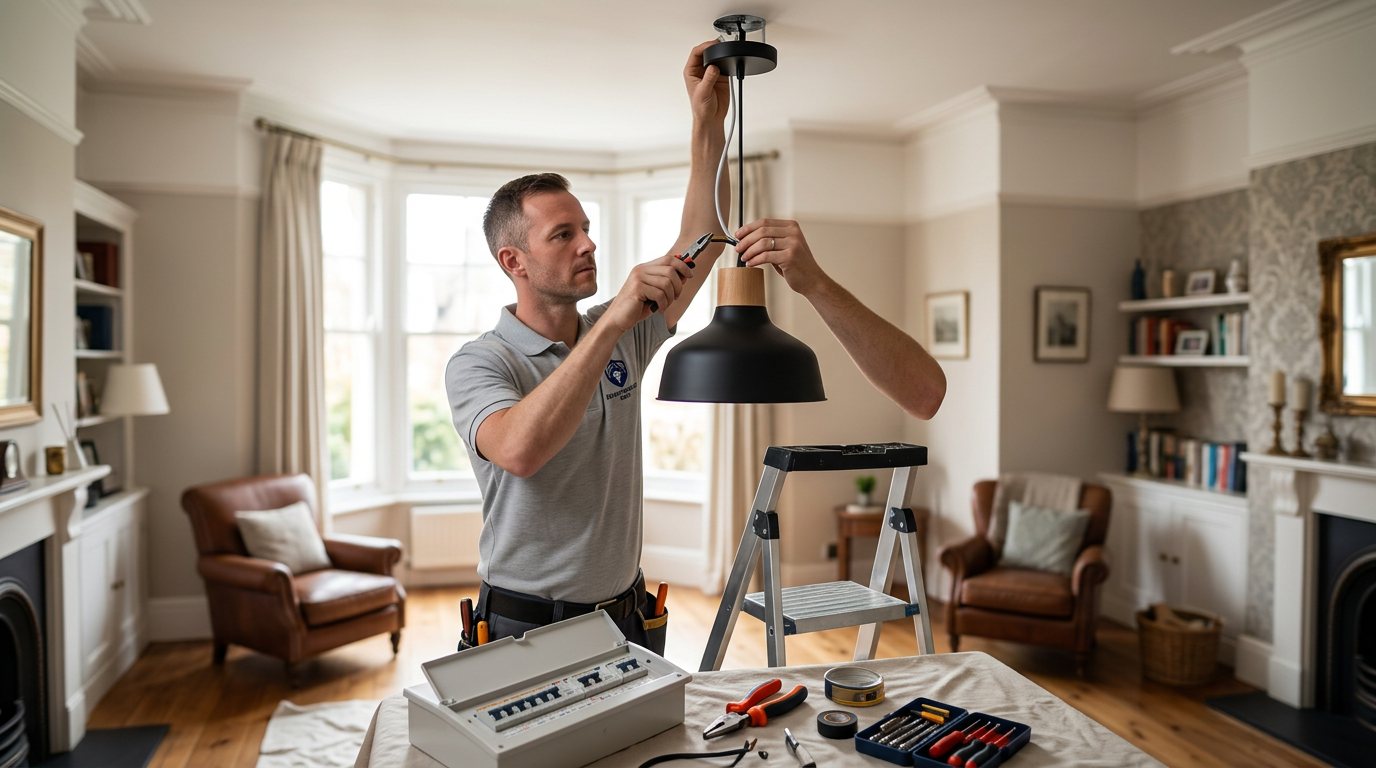
Lighting Fault Hidden Behind the Walls? We'll Hunt It Down in Birmingham
When the fault isn't at the fitting, the switch or the rose, it's in the cables between them — we trace hidden wiring faults with testing, not guesswork.
Booking fee plus hourly labour — the price is confirmed before any work starts.
What this costs
| Booked 14+ days ahead | £25 booking fee £85 per hour |
|---|---|
| Booked within 48 hours | £100 booking fee £65 per hour |
| Same-day call-out | £220 booking fee £45 per hour |
The booking fee secures the visit. Labour is then charged by the hour, so you only pay for the time the job actually takes.
Booking fee £25–£220
£25 + £85/hr booked 14+ days ahead, £100 + £65/hr inside 48 hours, £220 + £45/hr same day. Agreed before we arrive.
Covered under Lighting
Electrical › Lighting — one of 20 documented jobs in this section.
Same-day hidden wiring lighting fault
Urgent jobs can often be booked for today. Ask when you book and we will confirm the slot before you pay anything.
15 service areas
Birmingham, Coventry, Dorridge and 12 more across the West Midlands.
Most lighting faults announce themselves at something you can see — a bulb, a switch, a ceiling rose. The awkward minority don't. The circuit tests fine at every visible point and the light still doesn't work, or works intermittently, and the fault is somewhere inside the fabric of the building: a cable jointed under a floorboard fifty years ago, a conductor damaged when a picture hook went in, a junction box buried in the loft insulation. These faults take patience and the right instruments, and this page explains how we go about them.
Why Hidden Wiring Fails
Cables inside walls fail for physical reasons. A conductor can be damaged by drilling — a shelf bracket, a radiator bracket, a TV wall mount — sometimes dying instantly, sometimes nicked and failing months later as the damage corrodes through. Old cable degrades: earlier generations of insulation become brittle, especially where cables have run hot or been squeezed through joist holes, and brittle insulation eventually cracks and breaks the conductor or leaks between cores.
And the historic building trade left joints everywhere. Before modern wiring practice, it was routine to joint lighting cables in a box under the floor or in the loft with no record and no access. Those joints are often the oldest thing in the circuit, and when one fails, everything downstream fails with it — with nothing visible to explain why.
The Signs That Point Behind the Surface
Certain patterns suggest a hidden fault early: a light that died while every visible component checks out healthy; a whole section of a circuit out with no tripped breaker; a fault that began after building work, even work that seemed unrelated; or an intermittent fault that wiggling a wall or a floorboard seems to influence. If you know of drilling or renovation before the fault began, that history is worth its weight — tell us exactly where and when.
How We Trace a Fault You Can't See
This is where test instruments earn their keep. The engineer starts by establishing the shape of the circuit: where it leaves the consumer unit, which fittings it passes through, in what order. Continuity and insulation testing on the isolated circuit then localise the break to a section — between which fittings does the circuit go open, or leak to earth? From there, careful testing at each accessible point narrows the section further, and specialised cable-locating equipment can trace the route of a concealed cable through a wall or floor, putting the instrument's probe where the fault's signature is strongest.
Only when the location is established do we open anything — and as locally as possible. A joint under floorboards is reached through a single lifted board; a damaged cable run behind plaster may be reachable from above through the ceiling or from a nearby access point rather than a channel cut across the wall.
Repairing Without Wrecking the House
Once found, hidden faults usually have a clean repair. A damaged conductor is either rejoined in a proper accessible enclosure or, where the run is badly hurt, rerouted — often along an adjacent path that avoids the damaged section entirely. Brittle historic cable in the affected section is replaced rather than patched, because insulation that has failed in one place is usually failing in the next one too, and we'd rather you didn't meet us again over the next metre of the same run. Every joint is made in an enclosure that remains accessible under modern practice — no more joints buried for the next fifty years to find.
Making Good
We keep openings as small as the job allows and make good what we open, but we're honest about the limits: a board lifted from a floor is straightforward; a channel in a plastered wall needs a plasterer's finish, and we'll tell you that plainly at quoting stage rather than after.
When to Call Us
Book a visit when a lighting fault survives checks at every visible component, when a section of circuit dies without anything tripping, when trouble follows building or drilling work, or when an intermittent fault seems tied to floors or walls. Hidden faults rarely stay stable — they tend to progress from intermittent to permanent.
Book Your Hidden Fault Trace Today
The fewer assumptions, the fewer holes. Call Maintenance Men or book online, and tell us anything you know about the fault's history — building work, drilling, when it started. Qualified, fully insured electricians covering the West Midlands, tracing with instruments first and drills second.
How the price works
We charge a booking fee to hold your slot, then an hourly rate for the work itself. The fee changes with how soon you need us; the hourly rate changes with the slot you choose. You approve the price before we start, so there is no surprise on the invoice.
Booked 14+ days ahead
£25 booking fee
then £85 per hour of labour
Best value. Book the slot now, pay the smallest booking fee.
Booked within 48 hours
£100 booking fee
then £65 per hour of labour
For jobs that can wait a day or two but not a fortnight.
Same-day call-out
£220 booking fee
then £45 per hour of labour
Urgent problems: standing water, no heat, no power, leaks.
Book the slot
Choose the window that suits you and pay the booking fee. That holds your place in the diary.
We diagnose on site
The engineer confirms the cause and tells you what the job involves and how long it should take.
You approve, we work
Nothing goes ahead until you agree the price. Labour is then charged per hour at your slot rate.
Some lighting faults sit where you can't see them: in cables buried in walls and ceilings, in junctions tucked under floorboards decades ago. These are the slowest faults to find and the ones where guesswork costs the most. We trace them with proper test instruments and open as little of your home as possible.
What our customers say about our electrical service
4.6 out of 5 from 11 reviews
Does what it says on the tin
No complaints about the work itself — clear explanation, sensible advice, fair price. Booking online was easy enough once I found the right job page.
Job: Smoke Alarm Replacement
Fixed it, but took longer than expected
Work itself was fine and tidy. Communication beforehand was patchy — I did not get the confirmation message and had to ring to check the slot. Would still use again.
Job: Flickering Outdoor Lights
Turned up when they said
Third time we have used Maintenance Men, and the same experience each time: agreed price, proper explanation, job done in one visit. The hourly rate is fair for the standard of work.
Job: Appliance Causing Power Trip
Book Hidden Wiring Lighting Fault
Tell us what is happening and choose a slot. If you are not sure this is the right job, use the diagnosis panel — it narrows the problem down before you book.
- Booking fee confirmed up front
- Hourly labour, agreed before work starts
- Same-day slots for urgent problems








Questions people ask about hidden wiring lighting fault
Straight answers to the things customers ask most often before booking.
What does tracing a hidden wiring fault cost?
There's a booking fee when you book, then hourly labour at a rate that depends on how quickly we can attend. Hidden faults take longer to trace than visible ones, and we'll be straight about that — the engineer keeps you updated as the trace narrows, and the full price of any repair is quoted and approved before the making-good stage.
Is this something I could investigate myself?
No. Hidden fault tracing requires the circuit to be tested live and dead in specific ways with calibrated instruments, and the cables involved are buried, live and — with historic insulation — often brittle. Even finding the cable route is instrument work. The useful thing you can do is assemble the history: what changed before the fault, and where.
How will you find it without demolishing my walls?
Testing first: continuity and insulation measurements localise the fault to a section between fittings, then cable-locating equipment traces the concealed route and pinpoints the fault. Only then do we open the building, at the smallest practical access point — a single floorboard or a local ceiling access rather than a channel across a wall.
Could a hidden wiring fault be dangerous?
It can be the most serious kind, because nobody can see it degrading. Damaged or brittle cable inside a wall can leak current to earth or heat slowly with nothing visible until a breaker trips or something fails — and the fault that trips an RCD repeatedly is the same fault that could eventually do worse. Treat repeated trips or post-drilling faults as prompt bookings.
Will there be much damage to make good afterwards?
Usually little. Most hidden faults are reached through a lifted floorboard, a loft access or a small local opening, all of which we make good. Where a wall channel is genuinely unavoidable, we'll tell you at the quote stage so you can plan the decorating — no surprises after the fact.
Need hidden wiring lighting fault sorted in Birmingham?
Book a slot in the diary and pay only the booking fee up front. We confirm the rest before we start.